
ISO/IEC 27001:2022 Information Security Management Systems
Information Security Management Systems


It is essential to keep payment card data secure and free from breaches. Every business that handles card transactions must protect customer information from breaches and fraud. That’s where PCI DSS comes in. It’s the global security standard built to protect cardholder data. Your organization can achieve PCI DSS compliance by storing, processing and transmitting payment card data securely and safely. At INTERCERT we provide PCI DSS compliance assessment service to ensure your organization improve the system and achieve compliance standards.
Any organization handling cardholder data must adhere to a set of security requirements set forth by the Payment Card Industry Data Security Standard (PCI DSS). It has features for monitoring systems, limiting access, encrypting private information and safeguarding networks.
Merchants or Service Providers processing over 6 million card transactions annually.
Merchants or Service Providers processing 1 to 6 million transactions annually.
Merchants or Service Providers processing 20,000 to 1 million transactions annually.
Merchants or Service Providers processing fewer than 20,000 transactions annually.
Here is a general overview of the key steps your organization should follow to achieve PCI DSS compliance service:

Conduct an initial assessment to determine whether the current process meets the requirements of standards or frameworks.
Identify the scope to understand inclusions and exclusions, which establishes boundaries, supports, goal achievement, and a clear path to achieving success.
Ensures a streamlined workflow, aligning processes to achieve goals while maintaining efficiency and quality.
Identify, develop, and implement solutions to meet requirements, improving and optimizing them to remain effective and aligned.
Provide training to boost skills, awareness, and understanding of handling tasks, managing risks, and applying the best methods to improve the process and requirements of the standard or framework requirements.
Conduct an audit to examine compliance with standards or framework requirements and provide an assessment report that includes compliance evaluation and improvement areas.
Ensure constant process improvement to enhance outcomes and drive efficiency and overall performance.

Understanding of Business Context
Confirmation of Audit Scope
Assignment of QSA Auditor
Preparation of Audit Plan
ASV Scan accordance with the defined Scope

Opening Meeting
Confirmation of Scope
Collection of Evidence
Testing of control implementation & Effectiveness
Closing Meeting

Preparation of Draft Report
Client approval on Draft Report
Delivery of Attestation of Compliance (AOC) and Certificate of Compliance (COC)
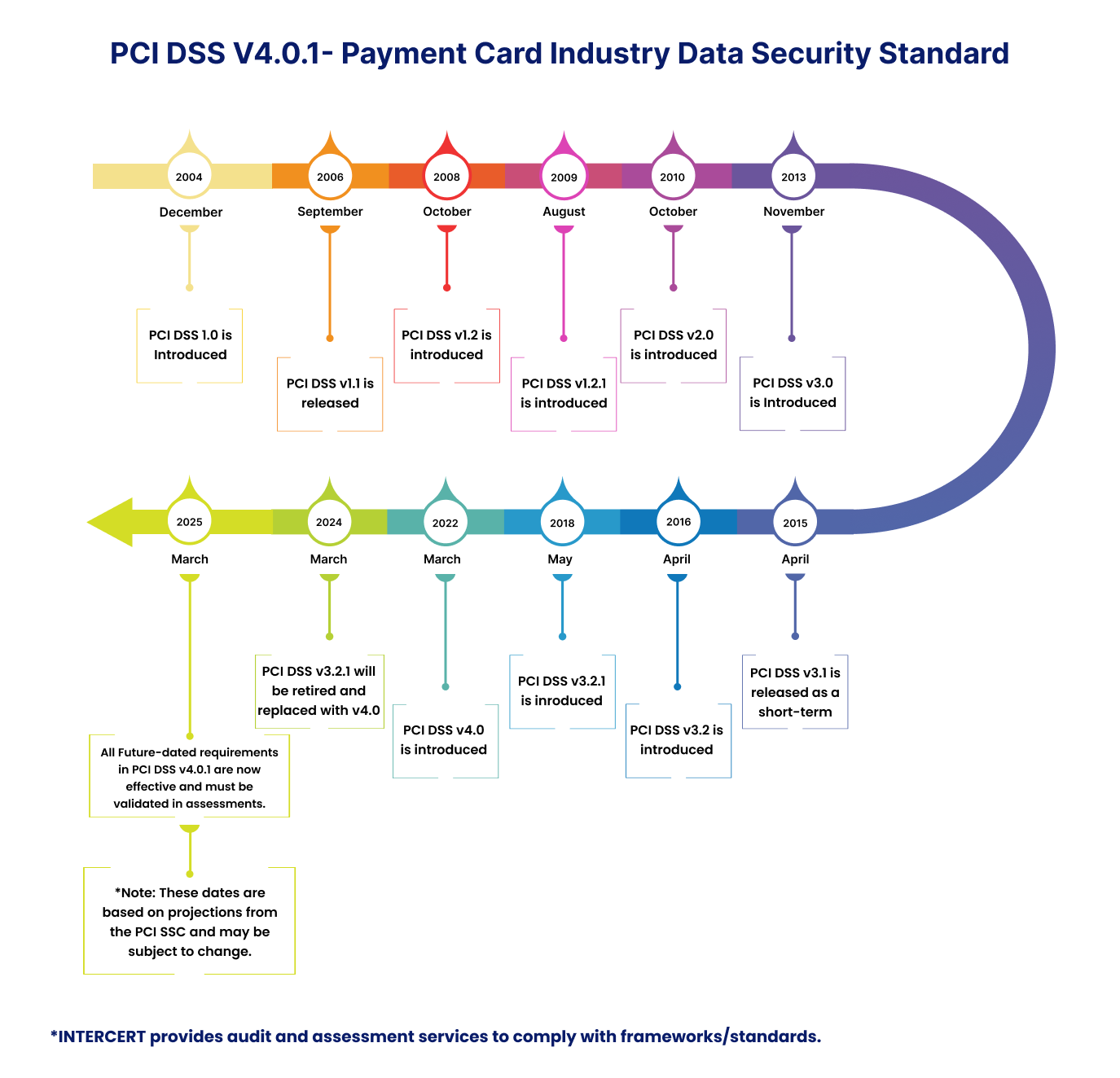
PCI DSS v4.0.1 has not introduced new requirements but has refined existing ones through clarifications, updated guidance, and minor formatting changes. The core principles of the standard remain unchanged and continue to provide a foundation for cardholder data protection, covering both technical and operational safeguards from network security to physical protections.
Configure and manage firewalls and segmentation rules to block unauthorized access into the cardholder data environment (CDE).
Remove default settings, disable unnecessary features and close misconfigurations to reduce any gaps.
PCI DSS v4.0.1 reinforces the ban on storing sensitive authentication data (SAD) post-authorization, except for issuer exemptions, and refines guidance on applicability.
Use secure protocols (e.g., TLS 1.2+) to prevent interception when data travels across untrusted networks.
Deploy and update anti-malware tools to shield CDE from malicious software.
Follow secure development practices and patch vulnerabilities quickly. PCI DSS v4.0.1 requires critical vulnerabilities to be remediated within 30 days, with non-critical fixes based on risk-based timelines.
Grant access only to individuals with a clear, legitimate business need.
Assign unique IDs, enforce strong authentication, and expand MFA usage to verify user access.
Use physical barriers such as locks, keycards, and access logs to secure devices containing CHD.
Maintain audit trails to capture user activities and review them regularly for anomalies.
Conduct vulnerability scans, penetration testing, and wireless assessments to uncover weaknesses before attackers do.
Implement governance, training and risk management to ensure continuous compliance. PCI DSS v4.0.1 clarifies that service providers must also assist customers by providing documentation and evidence upon request.
Protects sensitive cardholder data from breaches.
Builds customer trust and confidence in your brand.
Ensures compliance with industry and legal standards.
Reduces financial and reputational risks from data breaches.
Streamlines card holder data security processes for better efficiency.
Enhances your reputation and gives a competitive edge in the market.



 2001 Timberloch Place - Suite 500, The Woodlands, Texas 77380, United States
©2026 Intercert. All Rights Reserved


 +1 (281) 720-3261
 info@intercert.com